


This pilot study compares burnout levels among infection preventionists across two APIC chapters using the Maslach Burnout Inventory.
CRPI
The APIC Center for Research, Practice, & Innovation



The APIC Center for Research, Practice, & Innovation
The APIC Center for Research, Practice, and Innovation (CRPI) is dedicated to creating a clear and concise pathway from evidence generation for best practices to the dissemination of practice guidance and implementation tools. The Research Advisory Panel, Practice Guidance Committee, Health Equity Committee, Emerging Infectious Disease Taskforce, and Innovation Testing Lab are supported by the CRPI and actively support its multiple strategic initiatives.
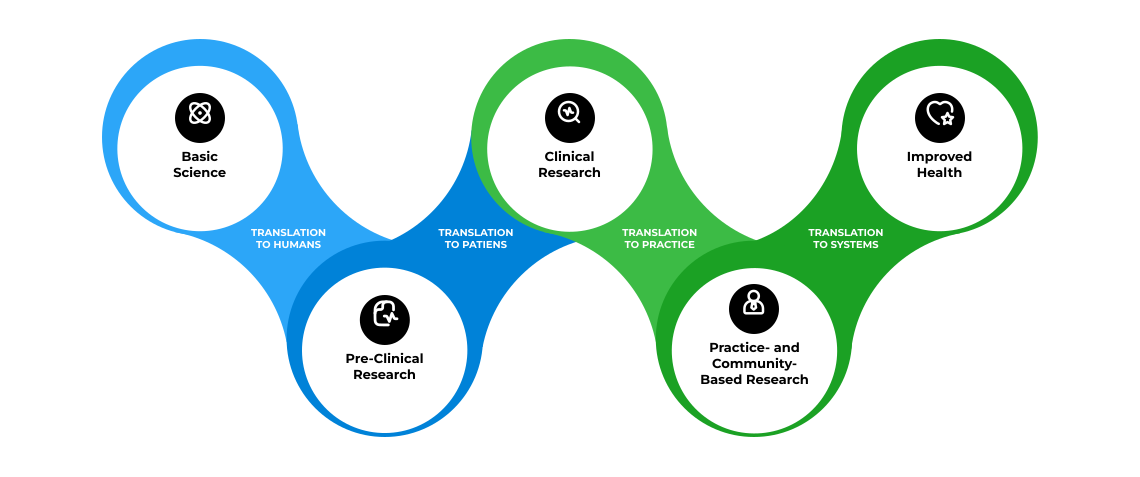
Research Pipeline
CRPI Initiatives
APIC offers various initiatives. Stay up to date with all the updates.


APIC Research Network
To advance the science and practice of IPC through infection-preventionist informed and led research and implementation science.

Research Agenda
View research gaps impacting the practice of infection prevention and control.

Research Awards
APIC showcases the most significant scientific abstracts during the Annual Conference.

MegaSurvey
The 2025 Mega Survey describes the current practice environment, addressing knowledge gaps and informing APIC’s future efforts in various areas.

Practice Resources
APIC provides evidence-based, scientific, and proven resources to infection preventionists, healthcare professionals, and patients.

APIC’s Commitment to Research
Through the CRPI, APIC intends to play a leading role in building research networks that advance collaborative scientific research across multiple entities. The CRPI aims to prioritize infection preventionist-informed researcah by building a dedicated team of scientists, researchers, and fellows to produce original research focused on advancing infection prevention and control practice.
Latest from the CRPI
WEBSITE
New
Retaining your infection preventionist: Top 10 factors that lead to retention in the US
This article describes the top factors that strongly linked to retention in the U.S. healthcare settings.
WEBSITE
New
Why do infection preventionists leave a job? A qualitative evaluation of infection preventionist attrition in health care
This article explores what drives IPs to leave their roles, using focus groups that include long-tenured IPs, those who transitioned roles, those who left the field, and IP leaders.
WEBSITE
The APIC Research Network (ARN)
The APIC Research Network (ARN) is now live and free to join in 2025! ARN connects infection preventionists, organizations, and industry to advance IP-led research and implementation science. Join today to grow your research skills, collaborate, and shape the future of IPC.
PDF
Implementation Guide to Preventing Catheter-Associated Bloodstream Infections in Adults (2025)
The purpose of this implementation guide is to provide information and tools to reduce the risk of infection due to catheter-associated bloodstream infections in various adult practice settings. It condenses evidence-based guidelines into key elements needed to mitigate risks and implement performance improvement processes.
CRPI Achievements
PDF
New
Guide to Preventing Catheter-Associated Urinary Tract Infections (2025)
This implementation guide provides key tools and evidence-based strategies to reduce infection risks from indwelling urinary catheters. It condenses guidelines into actionable elements for risk mitigation and performance improvement, supporting policy and protocol development across practice settings.
PDF
The Impact of Health Disparities and Inequities on Healthcare-Associated Infection: A Call to Action
The Impact of Health Disparities on HAIs: A Call to Action examines how SDOH and systemic inequities influence HAIs. Compiled by the APIC Health Equity Committee, it highlights key barriers, resource limitations, unconscious bias, and data challenges, while providing strategies to advance equity in infection prevention.
PDF
Infection Prevention Surveillance Plan Essentials for Long-Term Care: A Joint Resource from APIC and AAPACN
This resource helps long-term care facilities monitor infections and strengthen infection prevention and control strategies using data-driven approaches. The Centers for Disease Control and Prevention defines surveillance as the ongoing collection, analysis, and use of data to guide infection prevention efforts.
PDF
Implementing the Use of Enhanced Barrier Precautions in Skilled Long-Term Care Nursing Facilities: A Joint Resource from APIC and AAPACN
Enhanced Barrier Precautions (EBP) are an effective infection control intervention used to reduce the transmission of multidrug-resistant organisms (MDROs) in skilled long-term care nursing facilities. This practice guidance tool outlines when EBP should be implemented for residents, provides infection control recommendations for routine care activities, and includes case study examples with a self-quiz to help reinforce learning.
PDF
Resources for Infection Preventionists in Long-Term Care Settings: A Joint Resource from APIC and AAPACN
This tool was designed to provide Infection Prevention and Control resources to Infection Preventionists in Long-Term Care settings. These resources can be utilized to develop site-specific policies, plans, and procedures within the Long-Term Care setting.
PDF
Implementation Guide to Preventing Catheter-Associated Urinary Tract Infections (2025)
This implementation guide provides key tools and evidence-based strategies to reduce infection risks from indwelling urinary catheters. It condenses guidelines into actionable elements for risk mitigation and performance improvement, supporting policy and protocol development across practice settings
CRPI Publications
WEBSITE
Effectiveness of sodium hypochlorite against spores of 18 Clostridioides difficile isolates recovered from surfaces in 10 American hospitals
This study evaluates how effective sodium hypochlorite is at inactivating spores from 18 Clostridioides difficile isolates collected from environmental surfaces in 10 U.S. hospitals.
WEBSITE
Response to letter to the editor: “What constitutes an adequate sample size for monitoring hand hygiene adherence?”
This article responds to a letter to the editor by clarifying and discussing considerations related to defining an adequate sample size for monitoring hand hygiene adherence.
WEBSITE
A tale of two APIC chapters: A pilot study measuring burnout in infection preventionists using the Maslach Burnout Inventory (MBI)
WEBSITE
Retaining your infection preventionist: Top 10 factors that lead to retention in the US
This article describes the top factors that strongly linked to retention in the U.S. healthcare settings.
WEBSITE
PDF
Why do infection preventionists leave a job? A qualitative evaluation of infection preventionist attrition in health care
This article explores what drives IPs to leave their roles, using focus groups that include long-tenured IPs, those who transitioned roles, those who left the field, and IP leaders.This tool was designed to provide Infection Prevention and Control resources to Infection Preventionists in Long-Term Care settings. These resources can be utilized to develop site-specific policies, plans, and procedures within the Long-Term Care setting.
WEBSITE
Safe Injection, Infusion, Medication Vial, and Point-of-Care Testing Practices in Healthcare (2025)
This updated guidance outlines safe practices for injection, infusion, medication vials, and point-of-care testing, highlights recent outbreaks linked to unsafe practices, and offers new recommendations on contrast injections, ampules, drug diversion, and PPE use.
WEBSITE
Does routine use of sporicidal disinfectants for all postdischarge hospital rooms reduce environmental contamination with Clostridioides difficile spores?
This article examines whether routinely using sporicidal disinfectants in all hospital rooms after patient discharge reduces environmental contamination with Clostridioides difficile spores.
WEBSITE
APIC’s research priorities identified for 2025 and beyond
APIC released its third research agenda in September 2024 through the Center for Research Practice and Innovation (CRPI). APIC developed and published research agendas in 2000, 2012, and 2024 to address numerous questions in the ever-evolving field of infection prevention and control. This commentary piece outlines APIC’s research priorities for 2025 and beyond.
WEBSITE
Exploring the connection of health disparities and inequities with health care-acquired infections in North America: A scoping review of the literature
This scoping review highlights how social factors like race, income, insurance, and disability contribute to disparities in healthcare-associated infections. It calls for better data, targeted prevention, and policy change.
WEBSITE
Infection preventionists’ experiences and perceptions of health equity and the development of healthcare-associated infections: Focus group findings conducted from the Association for Professionals in Infection Control and Epidemiology (APIC) members
This article examines how infection preventionists view and address health equity in preventing healthcare-associated infections (HAIs). Based on focus groups with APIC members, key challenges include resource gaps, data limitations, social determinants of health, and unconscious bias. The study highlights the need for targeted tools, training, and partnerships to advance equitable infection prevention practices.
WEBSITE
Acknowledging the Gaps in Endoscope Reprocessing – A Call for Research to Inform Real-World Practice
This commentary discusses how endoscopes have been an essential tool in modern medicine, used in over 250 million procedures yearly. To prevent infection and ensure patient safety, these reusable devices must be reprocessed according to the manufacturer’s instructions. Despite established guidelines, gaps in the science of endoscope reprocessing remain, highlighting the need for continued research and improved practices.
WEBSITE
Right-sizing expectations for hand hygiene observation collection
Can hospitals maintain high-quality hand hygiene data with fewer observations? This study explores how reducing monthly observations to as few as 50 per unit could streamline monitoring without compromising accuracy.
WEBSITE
Infection preventionists experiences and perfections of health equity and the development of healthcare-associated infections
Infection prevention professionals are critical in addressing health inequities in health care. This study highlights key themes such as resource challenges, unconscious bias, and social determinants of health, providing valuable insights into advancing equitable care and reducing disparities in HAIs.
WEBSITE
Closing the gap on infection prevention staffing recommendations: Results from the beta version of the APIC staffing calculator
Discover how a novel calculator is reshaping infection prevention and control (IPC) staffing by using risk and complexity factors to generate individualized staffing ratios. Learn how this innovative approach aims to improve patient outcomes, optimize staffing, and address program complexities.
WEBSITE
A narrative review of how infection preventionist (IP) staffing and outcome metrics are assessed by health care organizations and factors to consider
Infection Preventionists are experiencing staffing shortages, the purpose of this narrative review is to understand how healthcare organizations track staffing and outcome metrics in relation to Infection Preventionists.